One of these years, I'm going to sign up for the Master Gardener program at the U. Until then, I think I've found a pretty good alternative. I've been volunteering to help Master Gardeners with their community gardening projects in my neighborhood.
It started a couple of years ago when I agreed to help clear a ditch to make way for a raingarden. Working alongside a couple of Master Gardeners, I learned to identify buckthorn and some other weedy trees. Better yet, I got my hands on a Weed Wrench. It's a great tool -- very effective, and fun to use. It's a bit pricey for something I need for a few hours, once or twice a year, but one the local Master Gardeners has one that she loans to people in the neighborhood.
Since then, I've helped with three or four other ongoing projects. For a little sweat and time, I've learned a lot about container gardening, native prairie plants, trees, insect pests, rain gardens, and edible weeds.
If you are free at noon on Sunday, September 13 and you want to learn about natives, consider helping with the Friends of Horton Park as they work on their native wildflower gardens.
Showing posts with label education of a gardener. Show all posts
Showing posts with label education of a gardener. Show all posts
Tuesday, September 08, 2009


Saturday, June 27, 2009
Insect Artists

This is about as good as it gets with insect pests: neatly nibbling interesting designs on an unwanted plant.
UPDATE: Thanks to Mary Schier's most recent post, I've learned that these leaves were cut by leafcutter bees. That should be easy to remember.
Here are a couple more articles about leafcutter bees: one written by an entomologist and one with some great photos.
Saturday, June 06, 2009
Tap Roots
Tap Roots, a raingarden initiative, kicks off Monday, June 8, with a gathering at the Hamline United Methodist Church raingarden, at the corner of Minnehaha Avenue and Simpson Avenue. Directions
Snacks will be provided, ideas will be exchanged, and we'll see what a ragtag bunch of neighbors/gardeners can do to promote raingardens and native plants.
Natives, with their deep root structures, are ideal for raingardens. Jonathan Dregni, the spark behind this meeting, has more to say about the benefits of natives in home gardens.
Raingardens don't have to be elaborate. I've found that there are some simple things we can do when designing a boulevard garden to capture rainwater and slow runoff.
Snacks will be provided, ideas will be exchanged, and we'll see what a ragtag bunch of neighbors/gardeners can do to promote raingardens and native plants.
Natives, with their deep root structures, are ideal for raingardens. Jonathan Dregni, the spark behind this meeting, has more to say about the benefits of natives in home gardens.
Raingardens don't have to be elaborate. I've found that there are some simple things we can do when designing a boulevard garden to capture rainwater and slow runoff.
Friday, May 08, 2009
Late Risers

Liatris takes its time waking from winter dormancy.
Nancy, the chief cook and bottle washer of The Vagary explains that liatris and some other prairie perennials have adapted to emerge after the risk of spring wildfires has passed.
Many perennial grasses fall into this category, too. I had been worried about the little bluestem I got from a neighbor late last fall, but it is finally showing signs of new growth.
I'm glad I didn't rip out the grasses, thinking that they had died. There's a reason to hold off working in the dirt until the second week of May.
Monday, July 07, 2008
Livin' la Vida Local
Saturday morning, a second annual pot-luck breakfast on the boulevard, one block away. Waffles, crepes, scrambled eggs that were from a coop 6 houses down the block. And several delicious baked goodies. Lots of catching up with old neighbors and meeting new ones.
Sunday afternoon, Market Days, five blocks away. An initiative of a local environmental group, the idea is that neighbors can bring their excess produce, crafts, or other vaguely related stuff to swap. I took a dozen potted perennials, mostly from divisions. Ten of them found new homes. For my efforts, I received a head of lettuce, a bunch of beet greens, two bars of hand-made soap, a few IOUs, and a dollar.
Some things were given freely, such as the serviceberries that Diane picked at a not-to-be-disclosed location, and lots of tips on edible weeds, such as Lamb's Quarters, Purselane, and Amaranth.
The group is going to try to make a weekly event out of this. Here's hoping it succeeds.
Sunday afternoon, Market Days, five blocks away. An initiative of a local environmental group, the idea is that neighbors can bring their excess produce, crafts, or other vaguely related stuff to swap. I took a dozen potted perennials, mostly from divisions. Ten of them found new homes. For my efforts, I received a head of lettuce, a bunch of beet greens, two bars of hand-made soap, a few IOUs, and a dollar.
Some things were given freely, such as the serviceberries that Diane picked at a not-to-be-disclosed location, and lots of tips on edible weeds, such as Lamb's Quarters, Purselane, and Amaranth.
The group is going to try to make a weekly event out of this. Here's hoping it succeeds.
Friday, May 30, 2008
Hail? No!
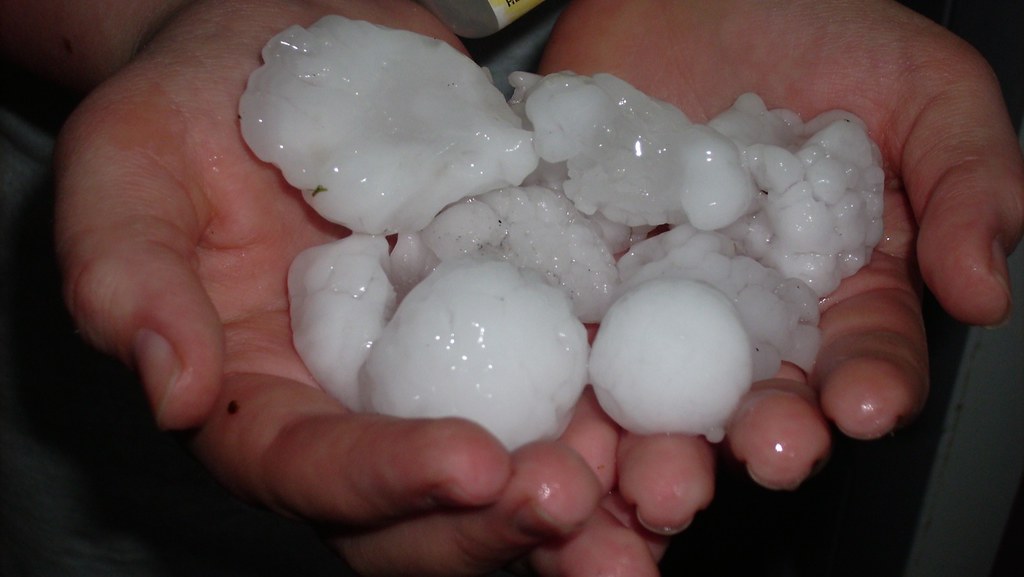
Last Saturday, the 24th, I went to the St. Paul Farmers' Market to buy plants for my aunt. I picked up tomatoes, peppers, and some annual flowers. I even stopped by Mother Earth Gardens in South Minneapolis to get a couple of tomatoes that were on her list but not at the market.
Sunday looked like a good day to plant, even though storms were forecast for the late afternoon. My daughter and I hopped in the minivan and headed north to Monticello.
Oh that I had heeded Michele's advice to wait until Memorial Day to plant.
We got done planting 16 tomatoes, 8 pepper plants, and 3 rows of beans before the storm clouds moved in. As we were picking up tools, the sirens sounded. And then the hail hit. Not just a little hail, but a lot of it. And much of it was large. There were three distinct waves of hail, each lasting several minutes.
My minivan got hit pretty bad, but not as bad as some of the newly planted tomatoes and peppers. I couldn't bear to take photos of them. Shredded leaves strewn around bare stalks.
If only I had thought to put upturned pots over the plants. That would have saved all of them.
Later that evening, we learned of the devastation and loss of life when a tornado, spawned by the same storm system, tore through Hugo. Put it all in perspective. I'll take the hail damage and drive up to replace the tomatoes that need replacing, while saying a prayer for those who lost much more elsewhere.
Sunday, May 11, 2008
Sunday Survey 2

Dandelions are beginning to bloom. Ugh. Now for the fun stuff:
BULB PERENNIALS
Daffodil, Narcissus
Grape hyacinth, Muscari
Tulips, Tulipa
PERENNIALS
Ginger, Asarum canadense
Japanese Spurge, Pachysandra terminalis
Periwinkle, Vinca
Prairie Smoke, Geum triflorum
Violets, Viola
SHRUBS
Serviceberry (photo above)
UPDATE: This shrub was labeled as a blueberry when I bought it, but thanks to an alert reader, I now know that it is a Serviceberry.
Saturday, November 24, 2007
Breaking the Rules

So I'm digging in the garden on a cold day in late November, all because someone made me an offer I couldn't refuse.
No, I didn't have to bury a body.
Elizabeth Licata, of Garden Rant, offered some bonus bulbs to her readers. I was lucky enough to respond in time.
Bulbs have to be spaced at least a few inches apart, and they need to be in the ground before the first frost. Or so I thought. We had our first hard frost November 7. Already, the top inch of soil is pretty much frozen solid.
I'll blame Elizabeth for leading me astray. She assured me that it was not too late, and she encouraged me to consider the Big Hole method of putting them in the ground.
So here they are.

Geranium daffodil bulbs on the top, Colorblends Miss Confection tulips below. Two hyacinth bulbs on the left. All sitting on an inch of compost and a sprinking of bone meal.
Can't wait to see how they look next spring.
Tuesday, October 23, 2007
Monkey See, and you can, too
Over at GardenRant, Susan Harris announced the debut of MonkeySee, a new site offering how-to videos. Susan has a series of clips about starting a sustainable garden.
Another of the initial gardening videos features Ed Bruske on composting.
Poking around the site, I found a nice juggling lesson. After years of being convinced that I could not juggle, I learned how when a relative shared three simple steps. These are the very same steps that David Sangillo demonstrates in his first four videos.
Now I just need to figure out how to juggle all the garden chores I need to get done before the snow flies.
Another of the initial gardening videos features Ed Bruske on composting.
Poking around the site, I found a nice juggling lesson. After years of being convinced that I could not juggle, I learned how when a relative shared three simple steps. These are the very same steps that David Sangillo demonstrates in his first four videos.
Now I just need to figure out how to juggle all the garden chores I need to get done before the snow flies.
Monday, October 15, 2007
Unseasonable
 These grape hyacinths must think it's spring. After I put these bulbs in a couple weeks ago, our weather didn't stay mild -- it got warmer. And now these are pushing up foliage. That's never happened to me before. In the future, I'll avoid planting bulbs out front until late October. And maybe I should bury them a bit deeper, too.
 One of the things I've learned is that I can get two different bloom times from the same bulb species, depending on where they are planted. The beds in front, with full southern exposure, warm up several weeks earlier than the beds in the backyard.
Tuesday, July 17, 2007
Patience

My blackberry lily produces a great number of seeds. Black and full, they are as big as ordinary peppercorns, and almost as hard when dried. I kept some aside through the winter, hoping to start them in the spring. When mid-April rolled around, I put some in a little 4-inch pot. I watered and watched. Weeks passed. Then a month. Nothing.
Wondering if the seeds were good, I placed a few between moist paper towels to see if I could get them to sprout. I even nicked a few of the hard seed casings, as I know that can help other hard seeds (like morning glories) germinate. For a couple of weeks, I faithfully kept those paper towels moist. Still, not a sign of life from any of the seeds.
I forgot about the little 4-inch pot, but as it was among some other potted transplants, it kept getting water. A few weeks ago, I noticed that most of the seeds had sprouted. And then I started seeing little seedlings here and there around the garden.

These grew from seeds I scattered about last autumn. They are a little shorter than their siblings in the pot, but I won't have to worry about transplanting them.
Another lesson learned. Some things can't be forced.
Subscribe to:
Posts (Atom)

